Research
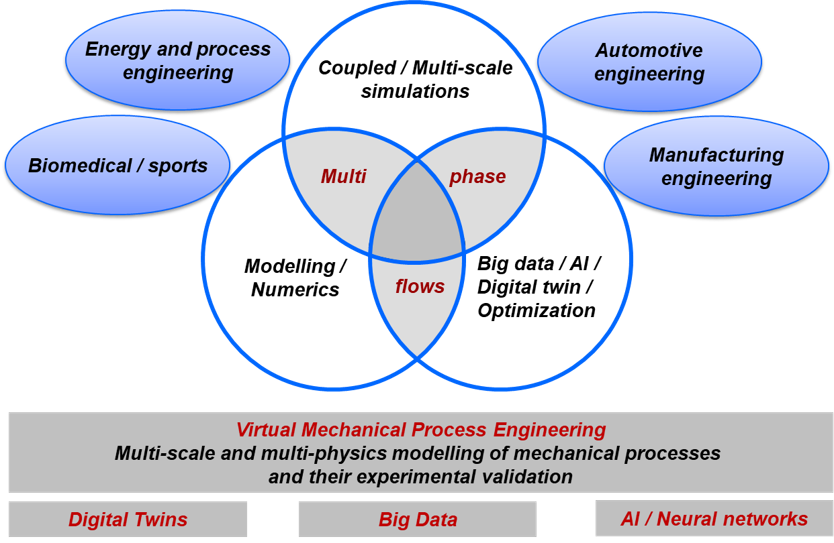
Industrial processes are determined by coupled momentum, heat and mass transport in multiphase systems. The main field of research is the mathematical description and experimental validation of multiphase flows and transport processes. Both dispersed systems (particle/droplet/bubble systems) and separated systems (flows with free surfaces) are considered.
Coupled methods (fluid-structure coupling, conjugate heat transfer, thermoelectric coupling) and immersed boundary methods are used to describe the problems.
Due to the different scales - from the microscale to the macroscale - multiscale modelling is required, which is also part of the research concept described below:
The multi-scale modelling is based on a coupling of models with different levels of detail or a coupling of 1D and 3D simulation models. Numerical flow simulation (CFD) and volumetrically resolved particle methods for the flow as well as the calculation of the adhesion forces of arbitrarily shaped particles on the basis of an immersed boundary method are used as numerical tools. Copied methods for describing the interaction of structure and fluid, conjugate heat transfer and thermoelectric coupling are also taken into account. An extension of adjoint methods for the optimisation of multiphase flows is also being established. Artificial intelligence methods (neural networks), big data and digital twins are already being used in various applications.
The development of numerical methods is closely linked to experimental validation, which is carried out in parallel. In particular, the experimental validation of coupled problems will be taken into account. New measurement techniques (film sensors) and the validation of measurement techniques (Coriolis mass flow meter) will be considered.
As the development of these methods and tools is of a general nature, the methods will be applied to various applications in the fields of energy, process, biomedical and production engineering as well as in the automotive industry.
The long-term goal of the research should ultimately lead to virtual mechanical process engineering, i.e. in future, complex processes in mechanical process engineering should be modelled in the early phases of product development, leading to optimised processes with a high level of sustainability.
Almost all projects are collaborations between different disciplines such as electronics, medicine, chemistry, physics and mathematics. The institute is networked with various centres. In addition, the Institute is integrated as an associate member of the Institute for Mathematical Modelling, Analysis and Computational Mathematics (IMACM) and the interdisciplinary centre for Applied Numerics and Scientific Computing.
Environmental technology
Our activities in the field of environmental technology range from the modelling and simulation of droplet separation in exhaust gas systems to the modelling of coupled heat transfer processes in turbomachinery and electrical devices in order to optimise energy consumption and reduce heat losses.