HyFilDrain: Development of energy-efficient coalescence filter media for hydrogen compression
The growing demand for hydrogen and its global transport via pipelines requires regular compression. This necessitates compressors fitted with high-performance coalescing filters to ensure the absolute purity of the hydrogen. The ‘HyFilDrain’ project aims to develop innovative filter media which, thanks to their targeted design, minimise pressure loss and thus offer significant potential for CO₂ savings.
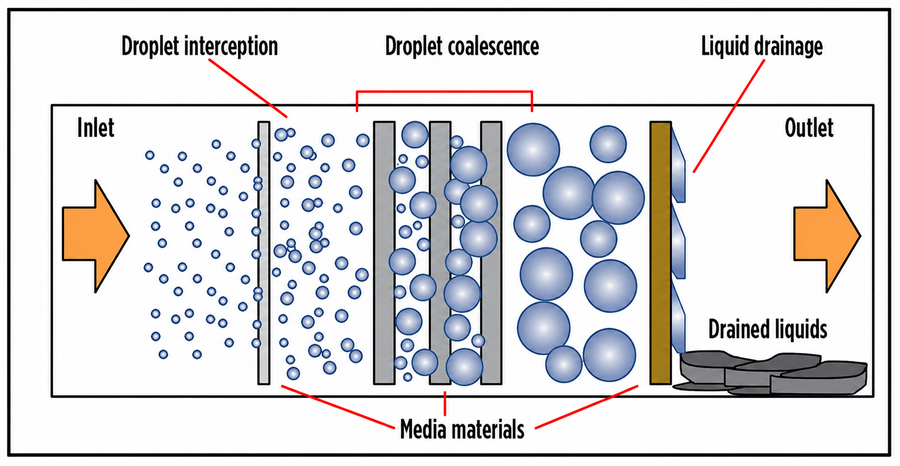
Our sub-project focuses on the detailed modelling and simulation of these filter systems. To accurately represent the complex fluid dynamic processes, we combine advanced numerical flow simulations with modern machine learning approaches. A current focus is on the Smoothed Particle Hydrodynamics (SPH) method. As a grid-free method, SPH is ideally suited to physically accurate simulation of the challenging multiphase flows and droplet coalescence at the individual filter fibres on the microscale.
This is complemented by research into and the use of Physics-Informed Neural Networks (PINNs). These networks integrate fluid dynamics directly into the learning process. This enables us to design computationally intensive models more efficiently, predict flow behaviour more precisely and successfully couple models across a wide range of scales – from the microscale of the fibres to the entire system.
These validated multi-scale models enable us to gain an in-depth understanding of the filter structures and to optimise them in a targeted manner. The practical validation of the results takes place in close cooperation with Hollingsworth & Vose GmbH.